

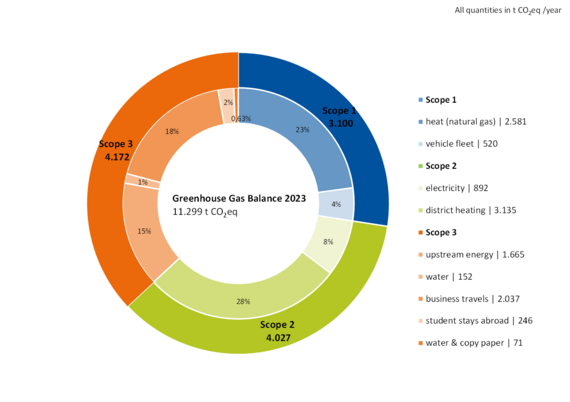
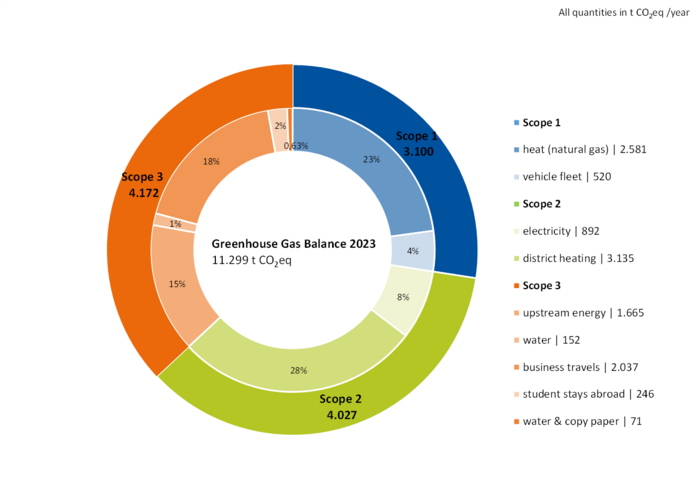

The greenhouse gas balance serves to identify significant sources of emissions and to quantitatively assess the success of all climate protection measures. The greenhouse gas balance sheet is therefore an important instrument for monitoring success on the way to achieving climate neutrality at Leibniz University. It is listed as measure 31 in Leibniz University's climate protection concept.
LUH's greenhouse gas balance is based on the Greenhouse Gas Protocol (GHG Protocol). This is a standardized method of greenhouse gas accounting, whereby emissions are categorized into three scopes. Scope 1 represents direct emissions, Scope 2 includes indirect emissions and Scope 3 a whole range of other indirect emissions from upstream and downstream processes that arise in connection with our activities outside the university. The accounting framework was drawn up in such a way that all energy consumption by third-party users is not taken into account. Among others, this applies to the Technical Information Library, the Gottfried Wilhelm Leibniz Library and the areas used by the student union.
Scope 1-3 contents
-
Scope 1 - direct emissions
The following was taken into account:
- Gas purchase
- Pellets
- Vehicle fleet
- Refrigerant
-
Scope 2 - indirect emissions
We currently use the market-based method. This approach means that the switch from conventional electricity generation to green electricity, which we completed in 2017, has a very positive impact on the balance sheet. As a result, the CO₂ impact for the majority of the electricity consumed can be set to 0. Only the “Campus Maschinenbau Garbsen (CMG)” site has so far been supplied with conventional power. However, we will also be using green electricity here from 2025.
To improve comparability, the greenhouse gas balance will be expanded in future to include the location-based method. In this context, we will balance our electricity volumes in a separate list with the emission factor for the German electricity mix. -
Scope 3 - indirect emissions from upstream and downstream processes
The following was taken into account:
- Gas procurement (upstream chains)
- Electricity procurement (federal electricity mix upstream chains)
- Electricity procurement (green electricity upstream chains)
- Electricity production PV systems (upstream chains)
- District heating (upstream chains)
- Peletts (upstream chains)
- Fresh water
- Waste water
- Business trips by employees
- Stays abroad by students
- Paper
- Waste
Due to a growing data pool, Scope 3 will be continuously developed in the coming years. The following Scope 3 items are to be included in the future depending on the data situation:
- Building emissions (emissions are amortized over the years)
- IT (amortization from the time of acquisition)
- Procurement of office and laboratory supplies
- Refrigerants
- Hygiene paper
- Mobility of students and staff to and from campus
- Excursions for students